class diagrams
Concept
Class diagrams
- captures structure of software design but not behaviour
- see plantuml/class-diagram
Visibility
+: public-: private#: protected~: package private- underline: static attributes/methods
=: indicate the default value
plantuml
@startuml
class Example {
    - hiddenAttr
    # protectedAttr
    + visibleAttr
    ~ pkgAttr
    {static} classAttr = null
    + publicMethod()
    - privateMethod()
    # protectedMethod()
    {static} classMethod()
}
@enduml
there is no default visibility, unlike the java access modifiers so leaving it blank means that the visibilty is unspecified, in general, absence means unspecified
Classifiers
- italics or with
{abstract}: indicates an abstract class <<interface>>: indicates an interface<<enumerations>>: indicates an enum
plantuml
@startuml
class Thing {
    - attribute
    + method()
}

abstract class AbstractThing {
		+ {abstract} abstractMethod()
		+ method()
}

interface -able <<interface>> {
    + {abstract} abstractMethod()
		+ method()
}

enum Enum <<enumeration>> {
    VALUE_A
    VALUE_B
}
@enduml
-
points up towards the super class
-
solid line with triangle: extends
-
dashed line with triangle: implements
plantuml
@startuml
class SuperClass
class SubClass
interface "-able" <<interface>>

SuperClass <|-- SubClass
"-able" <|.. SubClass
@enduml
- involving generics
plantuml
@startuml
class Box<T>
class SubBox<T>
class "Box<String>"
class StringBox

Box <|-- SubBox
Box <.. "Box<String>"
"Box<String>" <|-- StringBox
@enduml
java
class Box<T> {
}

class SubBox<T> extends Box<T> {
}

class StringBox extends Box<String> {
}
Associations
- connections between classes
- can show in the attributes compartment or with lines, but not both together
Roles
- closer to the boxes
- role of the object in the association
Labels
- can have arrow to indicate direction
- meaning of the association
plantuml
@startuml
class A
class B

A "[role of A]" -- "[role of B]" B : label >
@enduml
Navigability
- can b e uni- or bidirectional
- arrow indicates direction of reference (not in plantuml)
- A -> B, A has a reference to B
plantuml
@startuml
class Car
class Engine

Car -> Engine
@enduml
java
class Car {
	Engine engine;
}

class Engine
Multiplicity
0..x: optional, 0 to x objectsx: compulsory, must h ave x objects*: can have any number of objectsx..y: x to y objects inclusive
plantuml
@startuml

class Doctor
class Patient

Doctor "doctor" --> "0..*" Patient : treats >

@enduml
Composition
- strong whole-part relationship
- composition =>
- if the whole is destroyed, parts are destroyed also
- cannot be cyclical links
- ie. folders composed of subfolders, email composed of subject
plantuml
@startuml
class Book
class Chapter

Book *- Chapter
@enduml
depends on context also, chapters can exist outside of books if we are just gathering info about chapters
Aggregation
- container-contained relationship
- weaker than composition
- part can exist without the whole
plantuml
@startuml
class Team
class Person

Team o- Person
@enduml
Dependencies
- one class requires another for a short term interaction
plantuml
@startuml
class Foo
class Bar

Foo ..> Bar
@enduml
java
class Foo {
	// depends on Bar termporarily
	int calculate(Bar bar) {
			return bar.getValue();
	}
}

class Bar {
	int value;

	int getValue() {
			return value;
	}
}
don’t include the dependency if an association already implies it
Association class
- stores information about the association
- not possible in plantuml
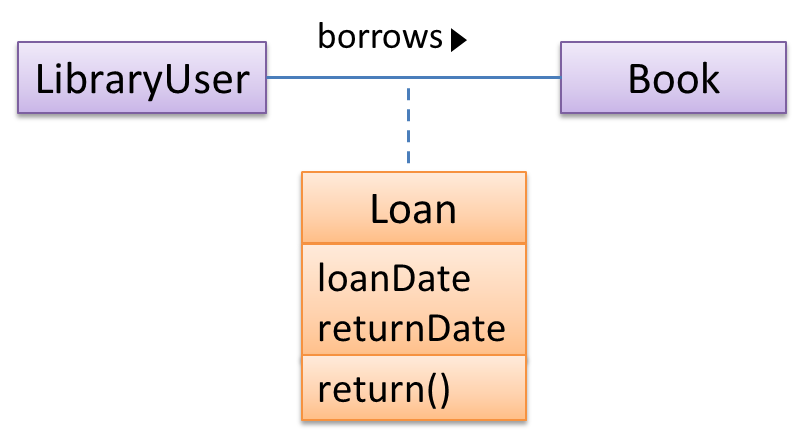
Conceptual Class Diagrams
- omit methods and navigability
- exclued solution-specific classes, used in the solution but not in the problem
Domain modeling
- modeling the problem domain
- how things actually work in the real world