random access protocols
Concept
- no a priori coordination among nodes
- transmit at full channel rate
- how to detect and recover from collisions
Slotted ALOHA
- divided into time slots, 1 frame per timeslot
- if no collision
- success
- if collision
- retry in subsequent slot with fixed probability
- max efficiency 37%, with many nodes
- slots wasted by collisions and empty
Pure ALOHA
- no time sync
- higher probability of collision
- if no collision
- success
- if collision
- wait 1 frame transmission time
- retry in subsequent slot with fixed probability
- max efficiency 18%, with many nodes
Carrier sense multiple access(CSMA)
- ALOHA - doesn’t check if other nodes are already transmitting
- listen before transmit
- sensed idle - transmit frame
- sensed busy - defer transmission until idle
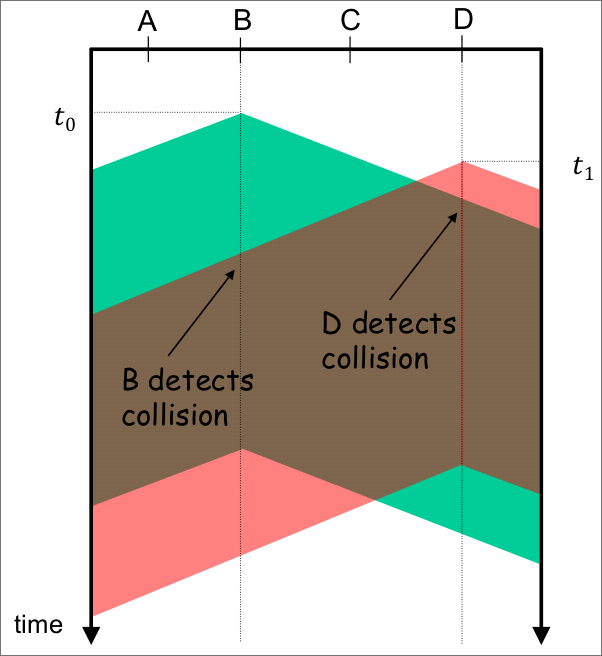
CSMA collisions
- still occur due to propagation delay
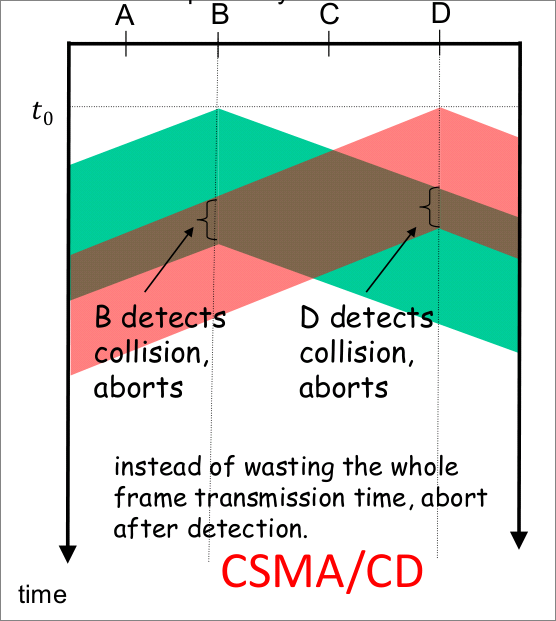
CSMA/CD
- ALOHA & CSMA - node doesn’t stop when collision is detected midway
- if collision detected - abort transmission
Fixed probability backoff
- probability of collision is fixed
- increases if multiple nodes start to transmit
Binary exponential backoff
- more collisions -> heavier load -> longer backoff
- at the
nthcollision, choose from{0, 1,..., 2ⁿ-1}, probability is 1/2ⁿ
Minimum frame size
- collisions might occur for other nodes
- but transmitters may no detect
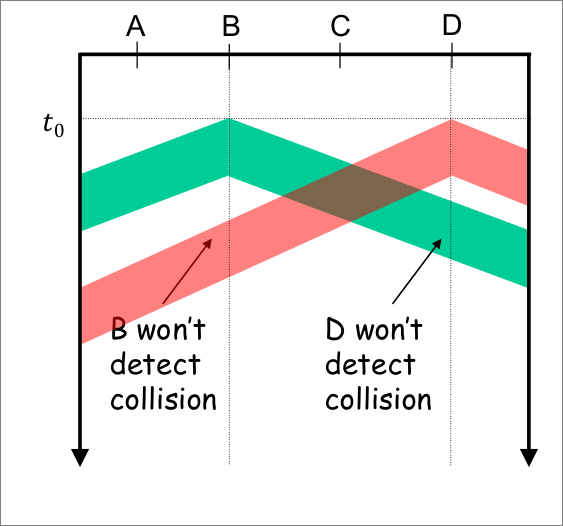
- fames need to be a certain size to garauntee detection
- based on the network’s diameter
- 64 bytes for ethernet
2 so that the nodes furthest away will still intersect