OS
Concept
Operating system
- aka. kernels
- the lowest level software, runs in the kernel mode
- program that acts as an intermediary between the user and the computer hardware
- other programs are run in the user mode
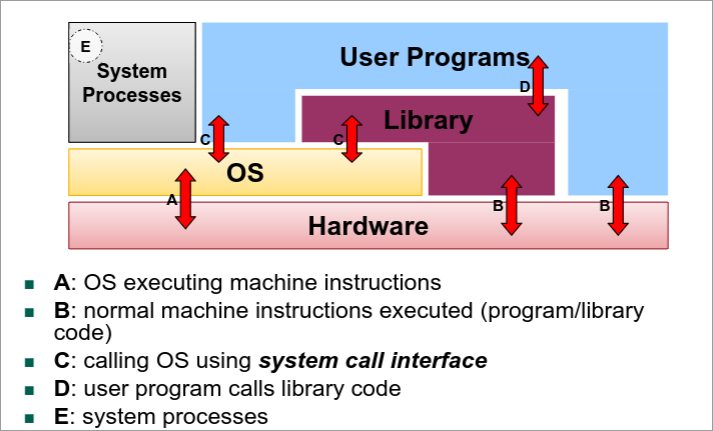
Abstraction
- programs interact with OS
- OS handles specifics of the low level, ie. drivers
- simplifies programming
- makes programs more portable
Resource allocation
- multiple programs can be run simultaneously
- OS manages CPU, memory and IO
- ensure efficient and fair resource allocation
Control
- programs might misuse the computer
- accidentally: bugs
- maliciously: virus/malware
- multiple users might share the computer
- OS prevents errors handles access control
OS structures
Monolithic
- OS is one big program
- services are packaged in the OS
- traditional approach, good performance but complex internal structure
Microkernel
- OS only provides minimal services
- inter-process communication(IPC), address space management, interrupt handler and thread management
- higher level programs need to use IPC to communicate
- more robust and better protection for the kernel but lower performance
Layered
- similar to monolithic
- OS is a hierachy of layers, lowest is hardware, highest is UI
Client-server
- variant of microkernel
- client process request service from server process
- server process runs on microkernel
- client and server can be on different machines
Virtual machines
- software emulation of hardware
- hypervisor runs VMs and monitors them
Type 1 hypervisor
- runs directly on computer hardware
Type 2 hypervisor
- runs as a program on the host OS