ext2
Concept
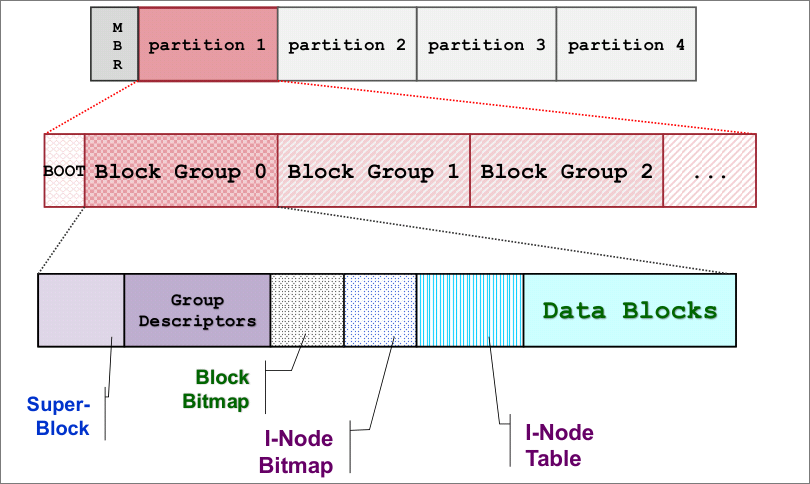
- blocks are grouped into block groups
- uses indexed allocation, files/directories use i-nodes
- contain file metadata and data block address
- fast access for small files + flexibility for huge files
Superblock
- one for whole file system, duplicated in each block group for redundancy
- describes the whole file system
- total number of i-nodes
- i-nodes per group
- total number of blocks
- blocks per group
Group descriptors
- number of free blocks/i-nodes
- location of the bitmaps
Block bitmap
- keep track of free blocks in the group
1- occupied,0- free
i-node bitmap
- keep track of i-nodes in the group
1- occupied,0- free
i-node table
- array of i-nodes for this group
- stores the file metadata
- i-nodes:
- fixed size
- 12 pointers - direct pointers, block with actual file data
- 13th - single indirect, block with direct pointers (2-level)
- 14th - double indirect, block with single indirect pointers (3-level)
- 15th - triple indirect, block with double indirect pointers (4-level)
Directory
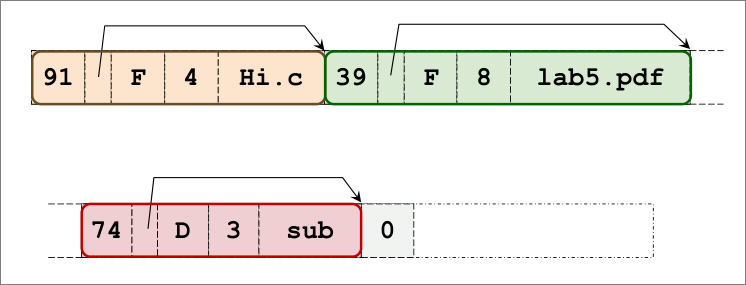
- directory’s data block -> linked list of directory entries
- contains:
- i-node number - look up the file in the i-node table
- pointer to next entry/size of this entry
- length of file/sub-directory name
- type - file or directory
- file/sub-directory name - 255 characters
Linking
Hard link
- two directory entries point to the same i-node
- i-node keeps track of reference count
- data is only deleted when reference count is 0
Symbolic link
- entry has its own i-node that points to the other directory entry
- only pathname is stored, need to search for the target i-node
- can delete original file -> dangling pointer