orders of growth
Summary
Adding orders of growth
- larger function takes precedence
- constants can be ignored
Concept
Rough measure of resources(time and space) used by a computational process, with respect to the problem size
OOG is an abstraction technique, ignoring details that seem to be irrelevant/external to the program
recurrence relations gives a good way of determining the OOG of recursive functions
Common orders of growth
Big O Notation
describe the asymptotic upper bound of an algorithm, or its worst-case scenario
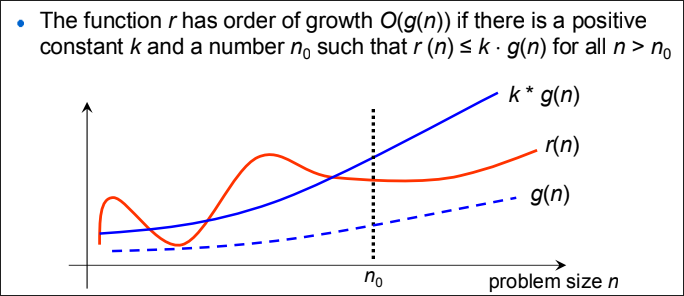
minor terms, ie. in
, and are not relevant since we can choose to overrule them
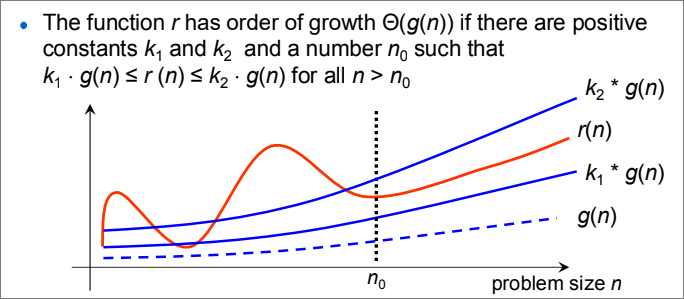
Big Theta Notation
describes BOTH the upper and lower bound of a function, sometimes referred to as the average time complexity
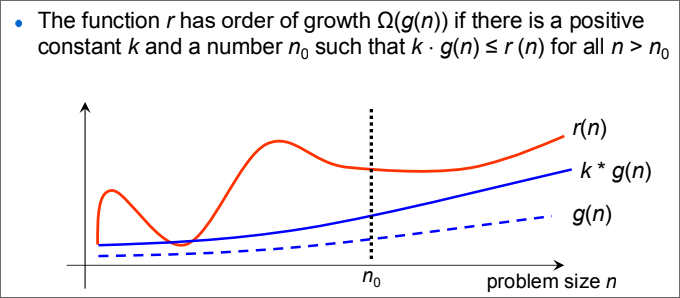
Big Omega Notation
describe the asymptotic lower bound of an algorithm, or its best-case scenario
Application
Recursive functions
const f = x => x === 1 ? x : f(x - 1); // T(n-1) + O(1)
const f = x => x === 1 ? x : f(x / 2); // T(n/2) + O(1)
for(let i = 0; i < n; i = i + 1) // T(n-1) + a
for(let i = 0; i < n; i = i * 2) // T(n/2) + a
for(let i = 0; i < 100 * n; i = i + n) // a
for(let i = 0; i< n * n; i = i + n) // T(n-1) + a