SE principles
Summary
Principles
| Principle | Definition | Key Idea |
|---|---|---|
| Single Responsibility Principle (SRP) | A class should have only one reason to change. | Keep each class focused on a single responsibility. |
| Open-Closed Principle (OCP) | A module should be open for extension but closed for modification. | Add new behavior in the implementation without changing existing code/specification. |
| Liskov Substitution Principle (LSP) | Subclasses must be substitutable for their base classes. | Subclasses should not break expected behavior. |
| Interface Segregation Principle (ISP) | Clients should not depend on methods they do not use. | Use smaller, specific interfaces. |
| Dependency Inversion Principle (DIP) | High-level modules should depend on abstractions, not concrete classes. | Reduce coupling via interfaces. |
| SOLID Principles | Acronym for SRP, OCP, LSP, ISP, DIP. | Core object-oriented design guidelines. |
| Separation of Concerns (SoC) | Divide code into distinct sections, each handling a separate concern. | Improve modularity and reduce ripple effects. |
| Law of Demeter (LoD) | Objects should only interact with closely related objects. | “Don’t talk to strangers.” |
| YAGNI Principle | Do not implement features until they are needed. | Avoid speculative development. |
| DRY Principle | Every piece of knowledge should have a single representation. | Avoid duplication. |
| Brooks’ Law | Adding manpower to a late project makes it later. | Communication overhead increases with team size. |
Concept
Single Responsibility Principle(SRP)
- a class should only have one responsibility
- it should only change if there is a change to that responsibility
- that way when something needs to be changed, only one class needs to change
Open-Closed Principle(OCP)
- make a code entity easy to adapt and reuse
- reuable without having to modify the entity itself
- open for extension but closed for modification
- similar to the command pattern, separate specification from implementation
Liskov Substitution Principle(LSP)
- derived classes must be substitutable for their base classes
- subclass should not be more restrictive than the behaviour specified by the superclass
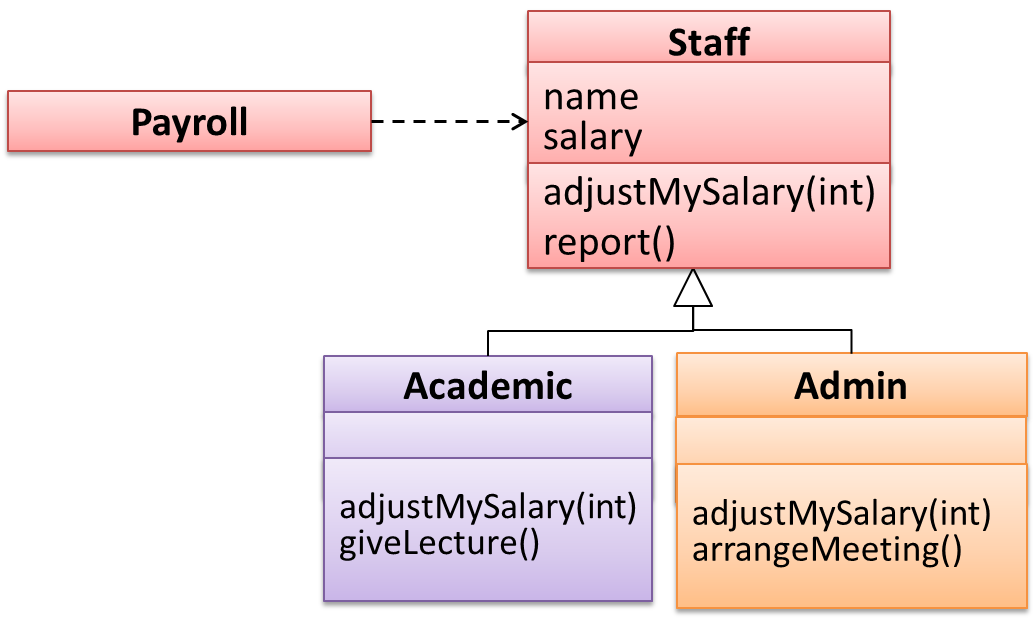
Staff#adjustMySalary - works with all +ve values
Admin#adjustMySalary - works with all -ve and +ve values
Academic#adjustMySalary - only works with 1..100
Admin- follows LSP, substituting it forStaffwill not break any functionality inPayrollAcademic- violates LSP, will not work for some values thatStaffallows
Interface Segregation Principle(ISP)
- no client should be forced to depende on methods it doesn’t use
- interface that the client depends on should be as lightweight as possible
Dependency Inversion Principle(DIP)
- high level modules should not depend on low level modules, both should depend on abstractions
- abstractions should not depend on details, details should depend on abstrations
- neutral interface that the concrete class(details) can inherit from, and that the higher level module can depend on
SOLID Principles
- SRP
- OCP
- LSP
- ISP
- DIP
Separation of Concerns Principle(SoC)
- improve modularity by separating code into distinct sections
- each section addresses a separate concern
- concerns - set of info that affects the code of the program:
- specific feature
- specific aspect - eg. security
- specific entity
- reduces functional overlaps among code sections
- limit ripple effect when changes are introduced
- higher cohesion with lower coupling
Law of Demeter(LoD)
- entity should have limited knowledge of other entities
- entity should only interact with objects that are closely related to it
- method
min objectOshould only know:- object
O - objects passed as arguments to
m - objects created in
m(directly or indirectly) - objects from the direct association of
O
- object
java
void foo(Bar b) {
    Goo g = b.getGoo(); // G is a stranger, not created by foo
    g.doSomething();
}
YAGNI Principle
- you aren’t gonna need it!
- do not add code just because it might be useful later
- cannot predict what will be needed in the future, so no point doing extra work
DRY Principle
- don’t repeat yourself
- every piece of knowledge must have a single unambiguous representation in a system
- don’t duplicate information/functionality
Brooks’ Law
- adding people to a late project will only make it later
- additional communication overhead will outweigh the benefits of adding extra manpower