threads
Summary
POSIX threads
TODO: self detach equal
| Syscall | Include | Function |
|---|---|---|
pthread_create(*id, NULL, function, arg) | <pthread.h> | creates a new thread that starts executing a specified function |
pthread_join(id, *retval) | <pthread.h> | waits for a thread to terminate and optionally retrieves its return value |
pthread_exit(retval) | <pthread.h> | terminates the calling thread and optionally returns a value |
pthread_self() | <pthread.h> | returns the thread ID of the calling thread |
pthread_detach() | <pthread.h> | marks a thread as detached so its resources are automatically released on termination |
pthread_equal() | <pthread.h> | compares two thread IDs to determine if they refer to the same thread |
c
#include <pthread.h>

// declaration
pthread_t thread_id;

// creating a thread
int *thread_function(void* arg) {
	// do work
	int *retval = ...;

	return retval; // return value
	// or
	pthread_exit(retval);
}
pthread_create(&thread_id, NULL, thread_function, arg);

// wait for thread to finish
int *retval;
pthread_join(thread_id, &retval);
compile with
-lpthread
Concept
Motivation
- forking is expensive, need to duplicate memory space and process context
- requires context switching
- most forks share some memory with parent
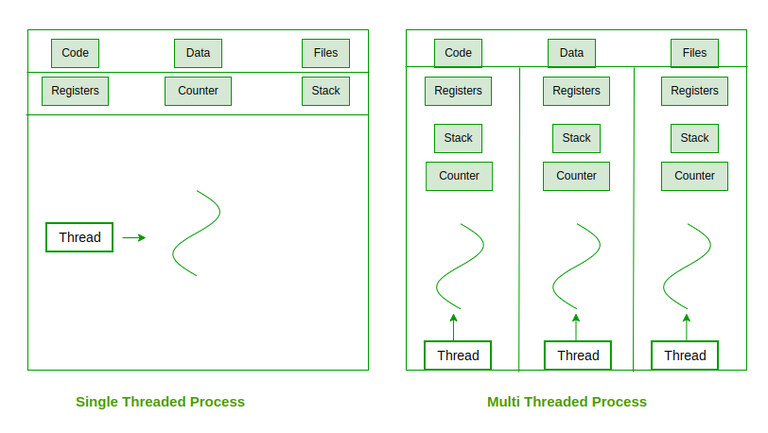
Threads
- lightweight process
- multiple threads of control in a single process
- can share:
- text, data, heap - memory context
- pid, shared resources - OS context
- cannot share:
- stack - each thread may run its own functions
- registers - each thread may make different computations
- thread id
| Benefit | Desc |
|---|---|
| Economy | multiple threads require less resources to manage compared to multiple processes |
| Resource sharing | share most memory + resources, no need IPC to pass information around |
| Responsiveness | more threads to be more responsive |
| Scalability | can benefit from multiple CPUs |
| Syscall concurrency |
- some syscalls are not thread safe
User thread
- only in user mode
- abstraction provided by program/library
- advantages:
- cross-platform
- library calls
- more configurable
- disadvantages:
- OS is unaware of threads, one thread blocked = process blocked
Kernel thread
- thread table in kernal mode
- advantages:
- kernal can schedule at the thread level
- disadvantages:
- thread ops are now syscalls, OS needs to manage
- less flexible, many features -> expensive + overkill
Hybrid thread model
- user threads can bind to kernel threads
Application
Thread creation and termination
c
#include <stdio.h>
#include <pthread.h>

void* sayHello(void* arg) {
	printf("Just to say hello!\n");
	pthread_exit(NULL);
}

int main() {
	pthread_t tid;
	pthread_create(&tid, NULL, sayHello, NULL);
	printf("Thread created with tid %i\n", tid);
	return 0;
}